Program Student Learning Outcomes (PSLOs)
At the completion of the Micronesian Studies Program, the student will be able to:
- Demonstrate the ability to read, speak and write critically and effectively in English about Micronesian Studies Program course content.
- Demonstrate proficiency in the geographical, historical, and cultural literacy of the Micronesian region.
- Demonstrate proficient knowledge of the structure and functions of the government and social, political, and economic issues concerning the Micronesian Studies course content.
- Demonstrate the ability to perform research and write papers relevant to Micronesia using different methods and technologies.
- Demonstrate an appreciation of the requirements of good citizenship in the FSM.
PSLO Assessment Report Summary
What we looked at:
PSLO 4 was identified to be assessed for the 2016-2017 cycle based on the previous assessments and recommendations.
PSLO 4 was assessed, using final research papers in two research courses in the program. The courses include Research methods (SS200) and Directed Study (SS280). The rubric looked at the following criteria: Thesis formulation, reliability of sources, analysis, synthesis, and process. Each category will be worth 4 points.
What we found:
PSLO # 4. Demonstrate the ability to perform research and write papers relevant to Micronesia, using different methods and technologies.
The target for successful achievement was that 70% of the class met the outcome with a score of 70% or higher. Figures 1 & 2 show the results.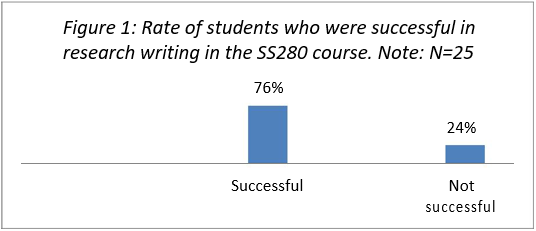
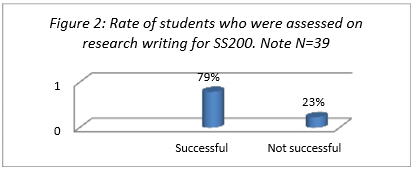
Table 1 shows average scores on each performance category for Research writing for SS280 Directed study course for both Fall2016 and Spring 2017 semesters.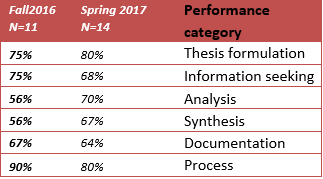
Assessment results in both semesters reveal that Analysis continues to be the weakest area, while Thesis formulation remains the strongest area. Detailed results of students rating on the seven areas are stated in Tables 1 &2.
Results show an improvement in both analysis and synthesis performances. Although the average score for synthesis category is at 67%, the outlook is positive because the performance is much higher than what was seen in Fall2016, which was a 56%. The slight improvement can be attributed to the change instructors made by giving more critical thinking exercises, beginning in the SS200 Research methods course. The change to focus on building critical thinking skills culminated from several earlier program assessment results, both from common essay assessment and research papers. It is also positive to note that the students’ ability to formulate thesis remains the strongest (80%) area of performance. Interestingly, there is a slight decrease on how students handled the use of sources, as indicated by the results for the categories on Information seeking and documentation. A possible guess for this could be the confusion students have between using MLA format from their expository writing courses, and APA format in the Social Science research courses.
Table 2 shows average scores on Assessment of Research writing for SS200 Research methods course for both Fall2016 and spring 2017 semesters.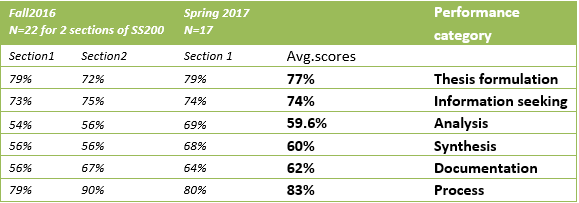
Students repeatedly show weakest performance in Analysis and Synthesis (59.6% and 60%) as average scores, as Thesis formulation and Process remain the strongest areas (77%, 83%) respectively. It has been observed that students come in with either little or no analytical skill. Another observation is that even collecting the correct sources of information is already a challenging task for students who enroll in the course. As a result, much of the tasks in the earlier weeks of the course are spent on helping students collecting and evaluating sources. The tasks involve collecting sources, and then determining the type of source, its validity, and reliability. A set of questions is used to help students perform the tasks.
Other assessment:
Each semester students taking SS280 are given an exit survey questionnaire to assess their overall experiences of the Micronesian studies program. The questions and their results, from both Fall2016 and Spring 2017 are seen on tables 3 & 4. Additional information that was also collected from the survey included students plans after completing the Micronesian studies program. Results are seen in Table 5.
Table 3 shows survey results from SS280 class for Fall2017.
| QUESTIONS | Strongly disagree | Disagree | Neutral | Agree | Strongly agree |
| 1. Instructors in your Micronesian studies program courses demonstrated knowledge of content | 2 | 9 | |||
| 2. Instructors in your Micronesian studies program courses seemed to sincerely care about you and your progress in your classes. | 1 | 10 | |||
| 3. Classroom atmosphere in your Micronesian studies classes seemed comfortable and supportive. | 3 | 8 | |||
| 4. Your grades in Micronesian studies program courses were an accurate assessment of your performance and mastery of subjects. | 3 | 8 | |||
| 5. You Micronesian studies program advisor was available to assist you when needed. | 1 | 2 | 8 | ||
| 6. Your Micronesian studies program advisor seemed to care about you and helped you to meet your academic goals. | 2 | 9 | |||
| 7. Your Micronesian studies program advisor helped you select courses that ensured you met graduation requirements. | 2 | 9 | |||
| 8. Your Micronesian studies program advisor assisted you with continued educational and career planning. | 3 | 8 | |||
| 9. You feel confident with the skills you acquired in the Micronesian studies program AA degree program for successful transfer to a 4-year college/university. | 3 | 8 | |||
| 10. You feel confident with the skills you acquired in the Micronesian studies program AA degree program to successfully obtain and maintain a job in this field. | 1 | 2 | 8 | ||
| 11. You feel that you increased your ability to design and conduct field studies in Micronesian studies program. | 2 | 9 | |||
| 12. You felt your experience in Micronesian studies program courses was enjoyable. | 1 | 10 | |||
| 13. You feel that the resources (e.g. textbooks, computer lab, classroom, etc.) in the program was adequate. | 1 | 10 | |||
| 14. You feel that you received a broad and adequate introduction to the Micronesian studies program after completing this program. | 3 | 8 |
Table 4 shows survey results from SS280 class for Spring 2017.
| QUESTIONS | Strongly disagree | Disagree | Neutral | Agree | Strongly agree |
| 1. Instructors in your Micronesian studies program courses demonstrated knowledge of content | 13 | ||||
| 2. Instructors in your Micronesian studies program courses seemed to sincerely care about you and your progress in your classes. | 13 | ||||
| 3. Classroom atmosphere in your Micronesian studies classes seemed comfortable and supportive. | 1 | 2 | 10 | ||
| 4. Your grades in Micronesian studies program courses were an accurate assessment of your performance and mastery of subjects. | 3 | 10 | |||
| 5. You Micronesian studies program advisor was available to assist you when needed. | 1 | 3 | 9 | ||
| 6. Your Micronesian studies program advisor seemed to care about you and helped you to meet your academic goals. | 2 | 11 | |||
| 7. Your Micronesian studies program advisor helped you select courses that ensured you met graduation requirements. | 1 | 2 | 10 | ||
| 8. Your Micronesian studies program advisor assisted you with continued educational and career planning. | 3 | 10 | |||
| 9. You feel confident with the skills you acquired in the Micronesian studies program AA degree program for successful transfer to a 4-year college/university. | 13 | ||||
| 10. You feel confident with the skills you acquired in the Micronesian studies program AA degree program to successfully obtain and maintain a job in this field. | 13 | ||||
| 11. You feel that you increased your ability to design and conduct field studies in Micronesian studies program. | 13 | ||||
| 12. You felt your experience in Micronesian studies program courses was enjoyable. | 1 | 12 | |||
| 13. You feel that the resources (e.g. textbooks, computer lab, classroom, etc.) in the program was adequate. | 1 | 1 | 11 | ||
| 14. You feel that you received a broad and adequate introduction to the Micronesian studies program after completing this program. | 1 | 12 |
Table 5 shows student-transfer information
| Exit survey | Fall 2016 | Spring 2017 |
| Returning to COM-FSM for a 2nd degree | 4 | 4 |
| Transferring to another university | 1 | 5 |
| Joined the US military | 1 | 0 |
| Transferring sometime in the future | 5 | 4 |
| Total | 11 | 13 |
What we are planning to work on:
- Team-teach one Micronesian studies course as another approach of instruction and assessment. Time of implementation will await outcome of Team teaching currently done in SS150History of Micronesia.
- Maintain class size for Research courses at a minimum of 15 students each section.
- Employ more critical thinking and writing exercises in SS courses to improve student performance in areas of analysis and reasoning.
- Gen. ed=Continue assessment of SS150, using team teaching and assessment of 3 key areas of recall (fill-in-blanks), recognition (Matching/multiple choice), and critical thinking (essay questions).
- Organize for activities (i.e., lecture forums, field trips, experiential learning, and others) to engage students in their learning. Need to coordinate with outside community in the planning of activities.
- Assess Outcome#5
- Students must have good reading and writing skills to articulate ideas, both in written and oral communication.
- Students seek advice of the Micronesian Studies Program advisors in terms of course-planning