Program Student Learning Outcomes (PSLOs)
At the completion of the Liberal Arts Program, the student will be able to:
- Enrich and deepen self-knowledge by exploring different academic experiences.
- Articulate and understand their experiences through effective writing, reading, speaking and various modes of artistic expression.
- Demonstrate fundamental knowledge and basic skills appropriate to their personal and professional goals in their chosen area of specialization.
PSLO Assessment Report Summary
What we looked at:
ASSESSMENT ACTIVITY: For the 2017-2018 SY, the division will be assessing the Transfer-ability of our students in the Liberal Arts program. These assessment activities will help us to assess PSLO # 3 which is: Demonstrate fundamental knowledge and basic skills appropriate to their personal and professional goals in their chosen area of specialization.
Target: 100% of all of our current Liberal Arts students will be assessed.
- The assessment will be three-fold: one-all of the instructors will analyze their advisee GPAs and identify how many students are able to transfer based only on their GPA. We will be looking to see how many students have a GPA above and below 3.0, which is a typically acceptable level for transfers. For new in-coming freshmen, their GPAs will be looked at by the end of the year to identify if they earned GPA levels that will allow them to transfer as well.
- The second part will be the administration of a survey for all LA students to identify factors that affect a student’s ability to transfer, their future goals, and their understanding of what it takes to transfer successfully to another college. Survey questions have already been drafted by the LA faculty and a tentative timeline has been established.
- The third and final part will be to use this data collected from the survey and hold workshops both at the end of the Fall semester as well as the beginning of the Spring semester to help address the issues identified, build skill/knowledge and to also introduce students to scholarships, tips and advice to actually help them transfer. Potential presenters have been identified and some areas to be addressed have been suggested. Other areas to be addressed will be identified based on the survey data.
- Advisors will work specifically with our potential graduates in assisting them to attempt to complete all tasks needed to transfer when graduating; the workshops will also be a means for the advisors to meet regularly with the new cohort of students to ensure that their courses selected and taken follow a specific transfer pathway based on their goals. Instructors will help the LA majors identify and develop specific pathways for transfer as well as help them graduate within the 100%-150% timeframe.
What we found:
As we analyzed the GPAs of our current advisees, here is what we were able to find:
Raw Data:
- Total # of advisees whose GPAs were looked at—70
- Total # w/GPA above 3.0—21 students
- Total w/no GPA yet (Freshmen)—14 students
- Total Males w/3.0 GPA: 6 students
- Total Females w/3.0 GPA: 15 students
Findings:
- 30% of the Liberal Arts advisees can transfer as they now stand.
- 71% of the students who can transfer now are Female 29% of the students who can transfer now are Male
- 2% of the advisees in the sample are Freshmen who don’t have current college GPAs.
- The Remaining 70% of Liberal Arts advisees have GPAs below 3.0 which makes them academically unqualified to transfer with their current standing. If they are here mainly to transfer, then their current GPAs are holding them back from that and will most likely lead to an extension of their studies and not meeting their projected graduation dates.
A survey with five questions were given to the Liberal Arts students to determine factors that affected their ability to transfer, their knowledge of the transfer process and what their goals are after they leave or graduate. Here is what we found:
Sample size: 50 students with 26 being Female and 24 males.
Question #1: Would you transfer to another institution if you had a scholarship?
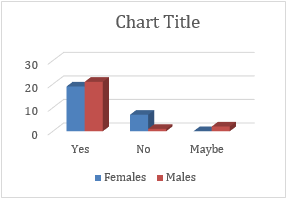
19 Females and 21 males responded yes to the question. Seven females said no, they would not transfer even with a scholarship compared to one male who said no and two who responded with “maybe”.
Question #2: What do you plan to do after you leave COM-FSM?
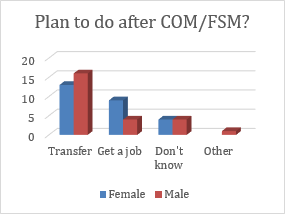
13 females said they would transfer after COM-FSM; 9 females said they would get a job and 4 responded with “Don’t know.” In comparison, 16 males said they would transfer after COM-FSM, 4 males plan to get jobs while 4 males were unsure. One male responded twice with maybe and Military.
Question #3: When is the best time to start the transfer process?
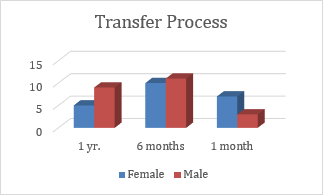
We found that a majority of the respondents felt that 6 months before you plan to transfer is the best time to start the transfer process with 11 males and 10 females while 14 (5 females and 9 males) felt one year was the best time and 10 students (7 females and 3 males) felt that one month prior is the best time.
*Although it is possible to complete the process within 6 months, it may not be the most feasible for our students since they may miss deadlines and not be able to get together all of the necessary documents. So with this data, our division will have to work on advising students to start the transfer process earlier if that is they plan so that they can have everything in place prior to transferring.
Question #4: Students were asked to rank from top to lowest the reason that would prevent them from transferring to another institution.

We found that money was the top reason for students not transferring with 25 respondents (12 female and 13 males) while family came in a close second with 22 students (12 female and 10 males) naming this as their top reason for not transferring. Only 3 students indicated that new culture or place was a top reason for them not to transfer (2 females; 1 male).
By finding out that money is the top issue, one way we can assist our students is to guide and help them find scholarships to help finance their educations. Some students are not aware of available scholarships so to help increase and improve chances for our students to transfer we need to work on identifying alternative sources of funding for them.
Question #5: Rank in order what you should do first in the transfer process:
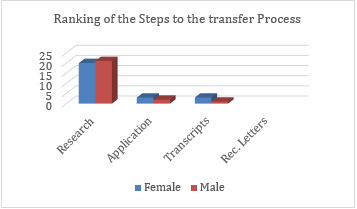
Based on our survey, it is apparent that more than half of our students understand that they need to do research in order to find out what is needed to be done if they plan to transfer. Forty-one of the respondents indicated that this is the first step (20 females; 21 males). Five indicated that filling out and sending in the application should be the first step while four respondents chose requesting transcripts as the first step. All of the respondents indicated requesting for letters of recommendation as the last step.
Although the students knew that they needed to do research, we were not able to ascertain as to what type of research they needed to do and what type of information they would need to find. This data has thus provided us with ideas on what kind of information we can help them find when they are working on transferring. Moreover, we can assist them in encouraging them to request transcripts and letters of recommendations in a more timely manner and that it does not necessarily need to be done when they start the process but can even be done prior to their starting the process.
What we are planning to work on:
ASSESSMENT ACTIVITY 2018-2019: The Liberal Arts Program has already in subsequent years, looked at the three PSLOs for the program and has conducted assessment activities for these PSLOs. As a result, for the SY 2018-2019, the Liberal Arts faculty have decided to do an overall assessment of the program’s PSLOs and its mission statement. The program faculty in doing the assessments of its students have found that for the most part, many of our students enter the program for three main reasons:
- They are undecided and are still in the exploratory stage of deciding what field or major they would like to pursue in their college studies,
- They have decided on a field of study but the college does not offer their selected major, so they are in the Liberal Arts program to complete their General Education requirements and strengthen other basic academic skills before transferring to another institution, and
- They want to enter a program that will enable them to gain general skills and graduate quickly so that they can then look for employment but they are unsure of what career to pursue.
DUTIES/TASKS TO COMPLETE:
- All faculty members will review the three PSLOs for the Liberal Arts program to better align the PSLOs to what we are doing in the program.
- All faculty will look at the program Mission and revise it to better describe the program’s purpose.
The division will meet three times during the semester to review, revise and finalize the PSLOs and the program mission. Tentative dates are as follows:
September 5th —Review/discuss possible changes to the mission and PSLOs
September 19th—Revisions
October 17th—Finalizing all suggested revisions/preparing for submission; also we plan to start working on our program review after the completion of the program assessment as our new due date is at the end of Spring 2019.
Recommendations for students:
- Read regularly: To help aid in coherence, comprehension and to expand background knowledge on content, students need to make reading a regular part of their everyday practice. Reading will help them more in their English courses and in any other courses in college since this will help to expand vocabulary and increase understanding of usage and will build knowledge of different subjects. To be successful in the Liberal Arts program, students need to read often and read regularly. Students should make it a habit to read ahead in their textbooks rather than relying on their instructors to provide all the information they need.
- Writing and Reflection: To become better at writing, students do need to practice writing. Putting thoughts into writing, reading what they write and reflecting on their writing is good practice. Writing about their reading can also help to aid understanding of unfamiliar subjects. For students to be proficient in writing, they must write.
- Students need to already start thinking and learning about their future careers so that when they enter into the Liberal Arts program, they will be informed about what types of skills and knowledge they will need for their future careers. Being aware of this will help students better plan their education and their career paths and will allow them to make good decisions when selecting classes and electives in the major.